
💡📈 Open source has two stories: the inspiring tale of programmers sharing code — and the practical story of licenses, business, and global infrastructure. Together, they explain how free code became the foundation of the internet. Explore the evolution of open source software, from early hacker culture to the technology powering today’s digital economy.

📖⚔️🌍 Two Stories, One Revolution
Open source software quietly runs much of the world.
It powers websites, smartphones, cloud servers, streaming platforms, online stores, and even parts of artificial intelligence systems.
But open source has two stories.
One is the inspiring story — developers sharing code to build a better digital world.
The other is the practical story — involving licenses, companies, infrastructure, and smart business decisions.
Both stories are true.
Let’s start with the inspiring one.
🌟 The Romantic Story of Open Source
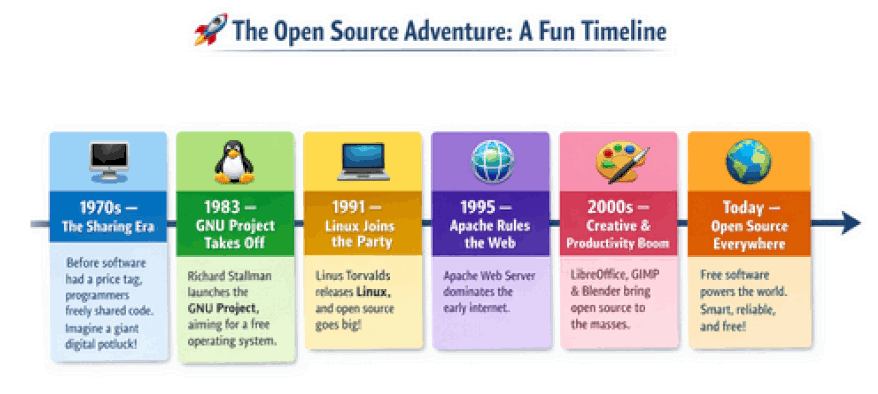
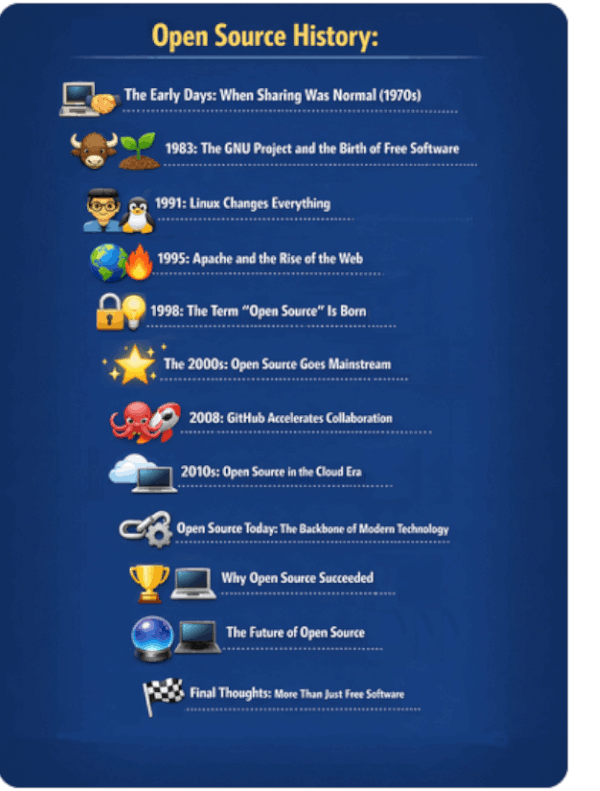
🖥️🤝 The Early Days: When Sharing Was Normal (1970s)
Before software became a massive industry, programmers often shared their code freely.
In universities and research labs, developers shared improvements the same way scientists publish research. If someone fixed a bug, they passed the solution along. If someone improved a tool, others could build on it.
It wasn’t a business model. It was just how things worked.
Think of it like a giant digital potluck — everyone brought something useful to the table — everyone benefited.
That culture of sharing planted the seeds of open source.
🌱🐃 1983: The GNU Project Sparks a Movement
In 1983, programmer Richard Stallman launched the GNU Project.
His idea was simple but powerful: software should give users freedom.
Not just free of cost — but free to:
- Run it
- Study how it works
- Modify it
- Share it
This philosophy became known as “free software.” It wasn’t only about technology — it was about digital rights and user control.
It was idealistic. And it inspired a generation.
🧑💻🐧 1991: Linux Changes the Game
In 1991, a Finnish student named Linus Torvalds released a small operating system component called Linux.
At first, it was just a hobby project.
But something remarkable happened: developers from around the world began contributing improvements over the internet. Bugs were fixed quickly. Features were added fast.
For the first time, large-scale online collaboration actually worked.
Linux proved that software built by a global community could compete with expensive proprietary systems.
That changed everything.
🌐🔥 1995: Apache Helps Build the Web
As the internet grew rapidly in the mid-1990s, one open source tool became incredibly important: the Apache web server.
It powered websites across the globe.
It was reliable.
It was flexible.
And it was free to use.
Open source was no longer just an idea — it was becoming the backbone of the web.
🔓💡 1998: The Term “Open Source” Is Born
In 1998, the term “open source” was officially adopted.
The new phrase made the concept easier for businesses to understand. It focused less on ideology and more on practical benefits like collaboration, transparency, and innovation.
Suddenly, companies started paying attention.
Open source was no longer seen as radical. It was seen as smart.
🌟💻 The 2000s: Open Source Goes Mainstream
During the 2000s, open source software became part of everyday digital life.
- Firefox gave users an alternative web browser
- MySQL powered dynamic websites
- WordPress made blogging easy
- Blender and GIMP offered creative tools
Open source was no longer just for programmers.
It was for businesses, creators, and everyday users.
🐙🚀 2008: GitHub Makes Collaboration Easy
In 2008, GitHub launched.
It didn’t invent open source — but it made contributing much easier.
Developers could copy projects (“fork” them), suggest improvements, and collaborate globally with simple tools.
Open source development became smoother, faster, and more accessible.
It felt like the revolution was complete.
But there’s more to the story.
⚙️ The Real-World Story of Open Source
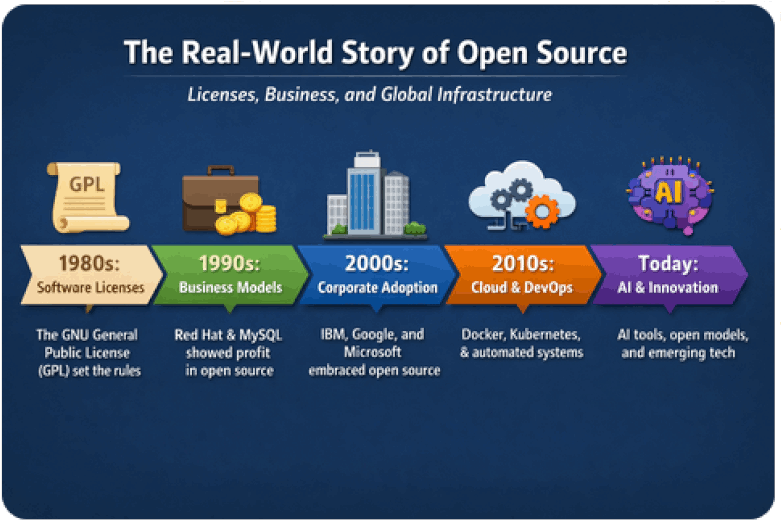
The inspiring story explains the spirit.
But the real-world story explains the success.
Open source didn’t just win hearts — it solved real technical and economic problems.
🏗️ Software Was Becoming a Business
Even in the 1970s, software was starting to become commercial.
Companies began charging separately for software instead of bundling it with hardware. Licensing models became stricter.
The sharing culture still existed — but business realities were changing fast.
Open source didn’t appear in a vacuum. It emerged in response to this shift.
🧾 Free Software vs Open Source: What’s the Difference?
The Free Software movement focused on ethics and user freedom.
The Open Source Initiative (OSI), founded in 1998, reframed the conversation around collaboration and business advantages.
Technically, many licenses were similar.
Philosophically, the messaging changed.
That shift made it easier for companies to adopt open source without feeling like they were joining a political movement.
🧠 Linux Is a Kernel (And Why That Matters)
Linux itself is technically a “kernel” — the core part of an operating system that manages hardware and processes.
When combined with tools from the GNU Project, it becomes a complete operating system often called GNU/Linux.
This detail may seem small, but it reflects how open source is often built: multiple projects working together.
🌍 Why Linux Actually Succeeded
Linux didn’t succeed just because it was free.
It succeeded because it was:
- Flexible
- Reliable
- Adaptable
- Scalable
Companies could customize it. Developers could improve it. Cloud providers could run it efficiently.
Today, Linux powers most web servers, much of cloud infrastructure, Android devices, and many of the world’s fastest supercomputers.
It became dominant because it worked — and because it evolved quickly.
🐙 Git vs GitHub: Clearing Up Confusion
Git is an open source version control system created in 2005.
GitHub is a company that provides hosting and collaboration tools built around Git.
Git is open source.
GitHub is a commercial platform.
Understanding that difference helps clarify how open source and business often coexist.
☁️ The Cloud Era and Corporate Adoption
In the 2010s, open source became central to cloud computing.
Technologies like:
- Docker (containerization)
- Kubernetes (container orchestration)
- TensorFlow (machine learning)
- Node.js (server-side JavaScript)
became industry standards.
Large companies — including Google, Microsoft, Amazon, and Meta — became major contributors to open source projects.
Open source didn’t replace corporations.
Corporations embraced open source because it accelerated innovation.
🤖 AI and the Modern Debate
Today, many artificial intelligence tools and frameworks are open source.
However, not all AI systems fully meet traditional open source definitions. Some share the trained model itself, but keep the training data and parts of the system private.
The discussion continues — just like earlier debates in software history.
🏆 Why Open Source Truly Won
Open source succeeded because it offers real advantages:
- Faster innovation through collaboration
- Transparent code review
- Lower development costs
- Reduced dependence on a single vendor
- Flexibility across different environments
It matches how modern software is built and deployed.
🔮 The Future of Open Source
Open source continues expanding into:
- Artificial intelligence
- Cybersecurity
- Blockchain systems
- Edge computing
- Government digital infrastructure
What started as a sharing culture in research labs now shapes global technology.
And it’s still evolving.
🏁 Final Thoughts: Two Stories, One Revolution
The romantic story of open source is about freedom and collaboration.
The real-world story is about smart engineering, sustainable licensing, and scalable infrastructure.
Both are true.
Together, they explain how open source didn’t just survive — it became essential.
Not because it was free.
But because it worked.
❓ Frequently Asked Questions About Open Source
Q1: What is open source software?
A: Open source software is software whose source code is publicly available. Anyone can view it, modify it, and share it with others. This encourages collaboration, transparency, and community-driven development.
Q2: Who started the open source movement?
A: The modern open source movement began with Richard Stallman and the GNU Project in 1983. Stallman emphasized software freedom, allowing users to run, study, modify, and share programs.
Q3: What is the difference between free software and open source?
A: Free software focuses on user freedom and ethics, while open source highlights practical benefits like collaboration, transparency, and business efficiency. Technically, they often use similar licenses.
Q4: Why is Linux so important in open source history?
A: Linux, released in 1991 by Linus Torvalds, is a kernel that forms the core of many operating systems when combined with GNU tools. It showed that community-driven software could compete with expensive commercial systems.
Q5: How did Apache contribute to open source success?
A: Released in 1995, the Apache Web Server became the most popular web server in the world. It demonstrated that free, community-driven software could handle enterprise-level reliability and scale.
Q6: What is Git and how is it different from GitHub?
A: Git is an open source version control system that lets developers track and manage code changes. GitHub, launched in 2008, is a commercial platform built on Git that simplifies collaboration and code sharing.
Q7: How has open source impacted cloud computing?
A: Open source software powers many cloud technologies like Docker, Kubernetes, and TensorFlow. Large companies like Google, Microsoft, and Amazon contribute to open source, making it central to modern cloud infrastructure.
Q8: Is AI open source?
A: Some AI frameworks and models are open source, but not all. Some release model weights while keeping training data or full systems proprietary. Open source AI is growing, but licensing and access vary.
Q9: Why has open source been so successful?
A: Open source thrives because it:
- Enables global collaboration
- Encourages transparency and security
- Reduces costs for businesses
- Supports rapid innovation
- Scales easily across different infrastructures
Q10: What is the future of open source software?
A: Open source continues to expand into AI, cybersecurity, blockchain, edge computing, and government systems. Its collaborative model ensures it will remain a foundation for future technology.
Categories