
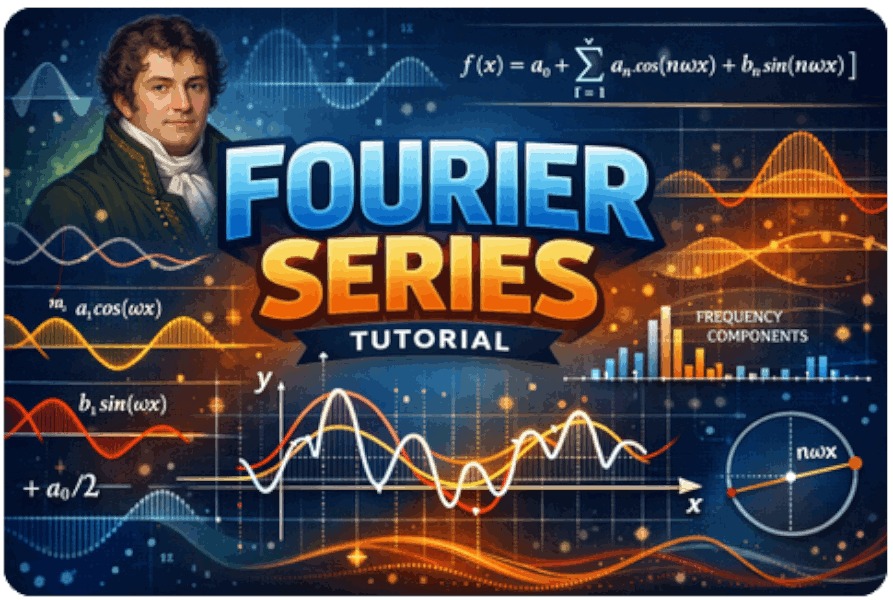
🔥Understanding Fourier Series begins with a simple but powerful idea: complex signals can be built from simple sine and cosine waves.
In this introduction, we explore why mathematicians use series expansions, the limitations of power series, and how Joseph Fourier discovered a method to represent periodic functions using trigonometric waves. This concept forms the foundation of modern signal analysis, physics, and engineering.

1. Why Series Expansions Matter
Expanding a function into a power series is an important technique in mathematics.
It allows us to:
- compute function values
- approximate difficult integrals
- study functions using simpler components
A classic example is the exponential function, which can be written as a power series.
\[ e^x = 1 + x + \frac{x^2}{2!} + \frac{x^3}{3!} + \dots + \frac{x^n}{n!} + \dots \quad x \in \mathbb{R} \]
This expansion can be used to approximate integrals that do not have a known elementary antiderivative.
For example:
\[ \int_0^1 e^{-x^2} \, dx \]
Using the power series of \( e^{-x^2} \), this integral can be computed with very high accuracy.
2. The Limitation of Power Series
Power series are powerful, but they have an important limitation.
The terms of a power series are not periodic, while many functions in physics and engineering are periodic.
When a periodic function is expanded into a power series, the periodic behavior of the function does not appear in the individual terms of the series.
For example, the sine function is periodic with period \( 2\pi \).
\[ \sin x = x - \frac{x^3}{3!} + \frac{x^5}{5!} - \dots \quad x \in \mathbb{R} \]
Although the function itself is periodic, the terms \( x,x^{3},x^{5},\cdots \) are not periodic.
3. A Natural Question
This leads to an important question:
- Can a periodic function be written as a series whose terms are themselves periodic?
Even more interesting:
- Can a non-periodic function defined on a certain interval be written as a series of periodic functions?
The answer is yes.
This idea was developed by Joseph Fourier (1768–1830) and later placed on a rigorous mathematical foundation.
Fourier showed that many functions can be expressed as a sum of sine and cosine waves.
4. The Fourier Series
The basic form of a Fourier series is
\[ \frac{a_0}{2} + \sum_{n=1}^{\infty} \left( a_n \cos(nx) + b_n \sin(nx) \right) \]
Each term in this series is a periodic function.
5. Theorem — Periodicity of the Terms
Each term of the Fourier series is periodic with period \( 2\pi \).
In other words, if
\[ t_n(x) = a_n \cos(nx) + b_n \sin(nx) \]
then
\[ t_n(x + 2\pi) = t_n(x) \]
Proof
Consider the cosine term first.
\[ \cos(n(x+2\pi)) \]
Using properties of cosine:
\[ \cos(n(x+2\pi)) = \cos(nx + 2n\pi) \]
Since cosine has period \( 2\pi \),
\[ \cos(nx + 2n\pi) = \cos(nx) \]
Similarly for the sine term:
\[ \sin(n(x+2\pi)) = \sin(nx + 2n\pi) \]
Because sine is also \( 2\pi \)-periodic,
\[ \sin(nx + 2n\pi) = \sin(nx) \]
Therefore,
\[ t_n(x+2\pi) = a_n \cos(nx) + b_n \sin(nx) \]
which equals
\[ t_n(x) \]
Thus each term of the Fourier series is periodic with period \( 2\pi \).
This completes the proof.
6. Key Idea
Fourier's insight was simple but powerful:
- A complicated function can be built from simple sine and cosine waves.
These waves act as building blocks for periodic functions, forming the foundation of Fourier analysis.
Back to the Fourier series explained tutorial list
Back to the tutorial list
Author
Categories