
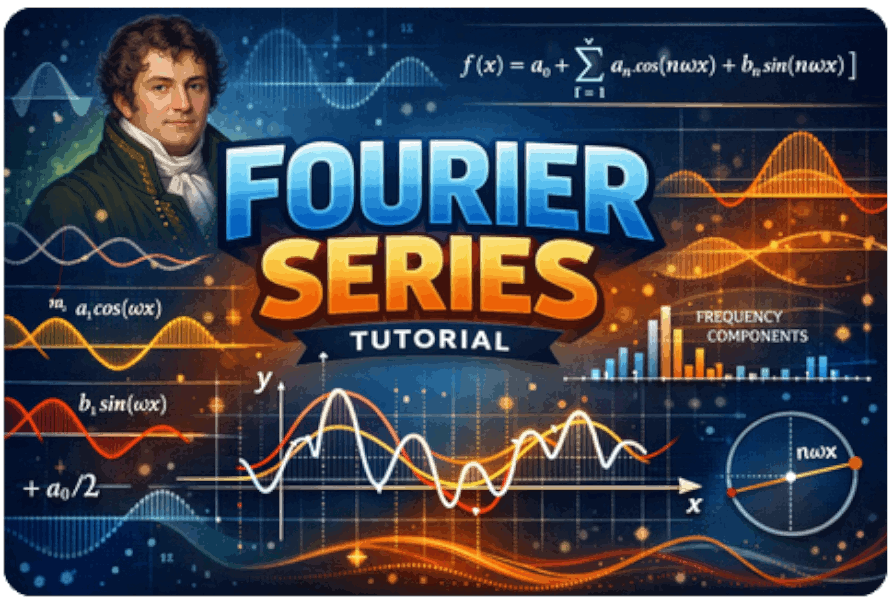
🔥 Fourier series reveal a remarkable idea: many complex periodic signals can be represented or approximated as combinations of sine and cosine waves. This powerful concept, developed while studying heat flow, is now fundamental in mathematics, physics, and engineering.

1. The Historical Origin
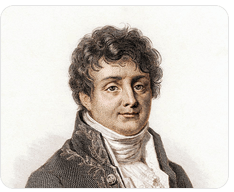
The concept of Fourier series comes from the work of Joseph Fourier (1768–1830).
In the early 1800s, Fourier studied heat flow and asked a simple but profound question:
- How does heat spread through a solid object over time?
While developing the mathematics of heat conduction, he discovered something remarkable: Many periodic phenomena can be represented as sums of sine and cosine waves.
This idea was first published in his famous book:
- Théorie analytique de la chaleur (1822)
This discovery later became the foundation of Fourier Analysis, a field that studies how complex signals can be decomposed into simpler wave components.
2. Why Fourier Series Are Needed
Many real-world signals are complex and irregular, such as:
- sound waves
- electrical signals
- vibrations
- temperature variations
These signals are often difficult to analyze directly.
Fourier's key insight was:
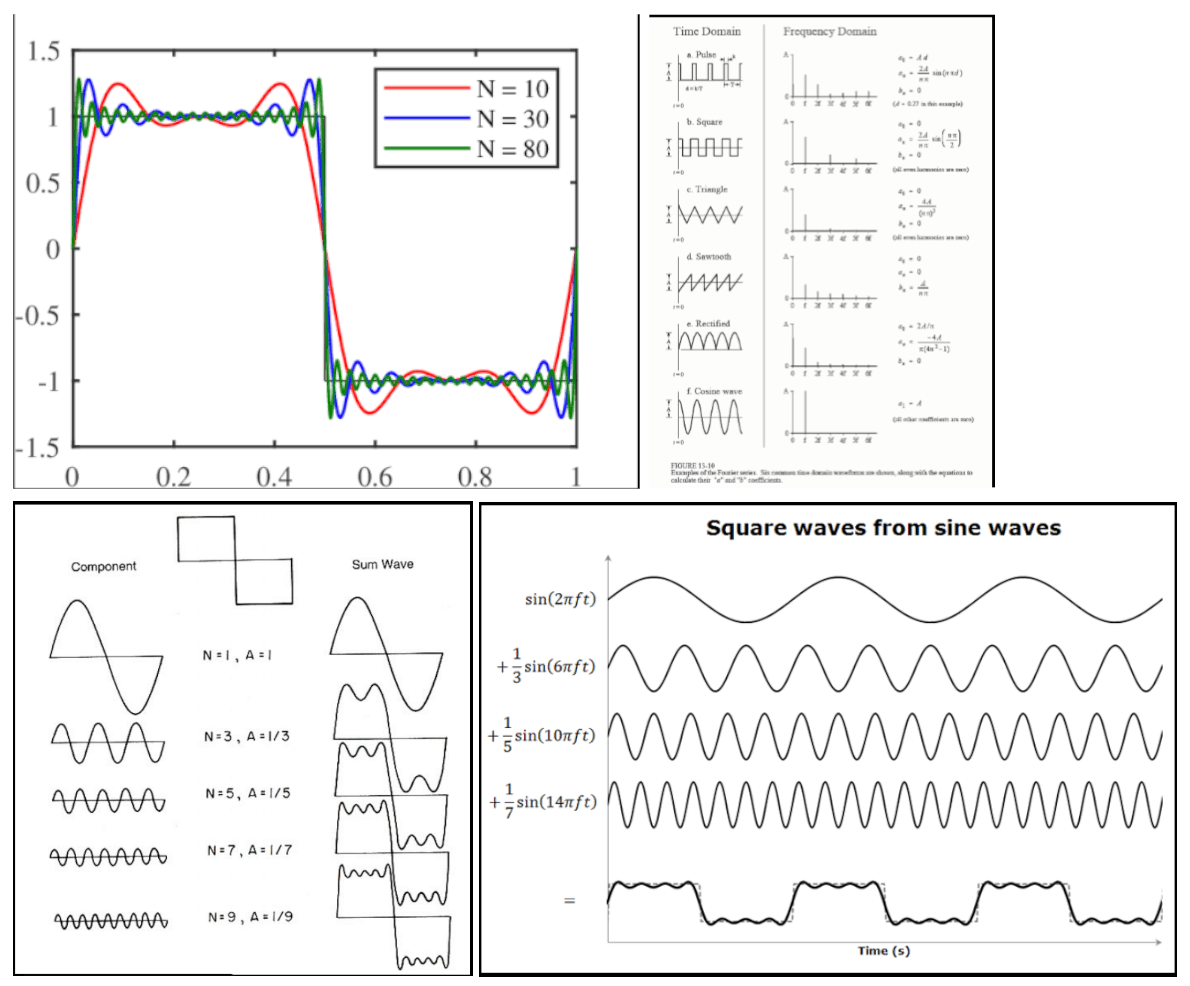
- Many periodic signals can be represented or approximated by sums of simple sine and cosine waves.
Many complicated periodic waveforms can be represented or approximated by sums of sine and cosine waves, called a Fourier series:
\[ f(x)=a_{0}+\sum_{n=1}^{\infty }(a_{n}\cos(nx)+b_{n}\sin(nx)) \]
⚠️ This form assumes a function with period 2π. More general periodic functions use a fundamental frequency parameter.
Each part of the formula has a specific meaning:
- \( a_{0} \) : the constant (DC) component of the function
- \( a_{n} \) : the cosine components
- \( b_{n} \) : the sine components
- n : the harmonic index
The coefficients determine how much of each wave contributes to the final signal.
This means a signal can be described as:
- a fundamental frequency
- plus harmonics (multiples of that frequency)
A useful analogy is music: a chord can be broken down into individual notes, just as a signal can be decomposed into individual frequencies.
3. What Fourier Series Are Used For
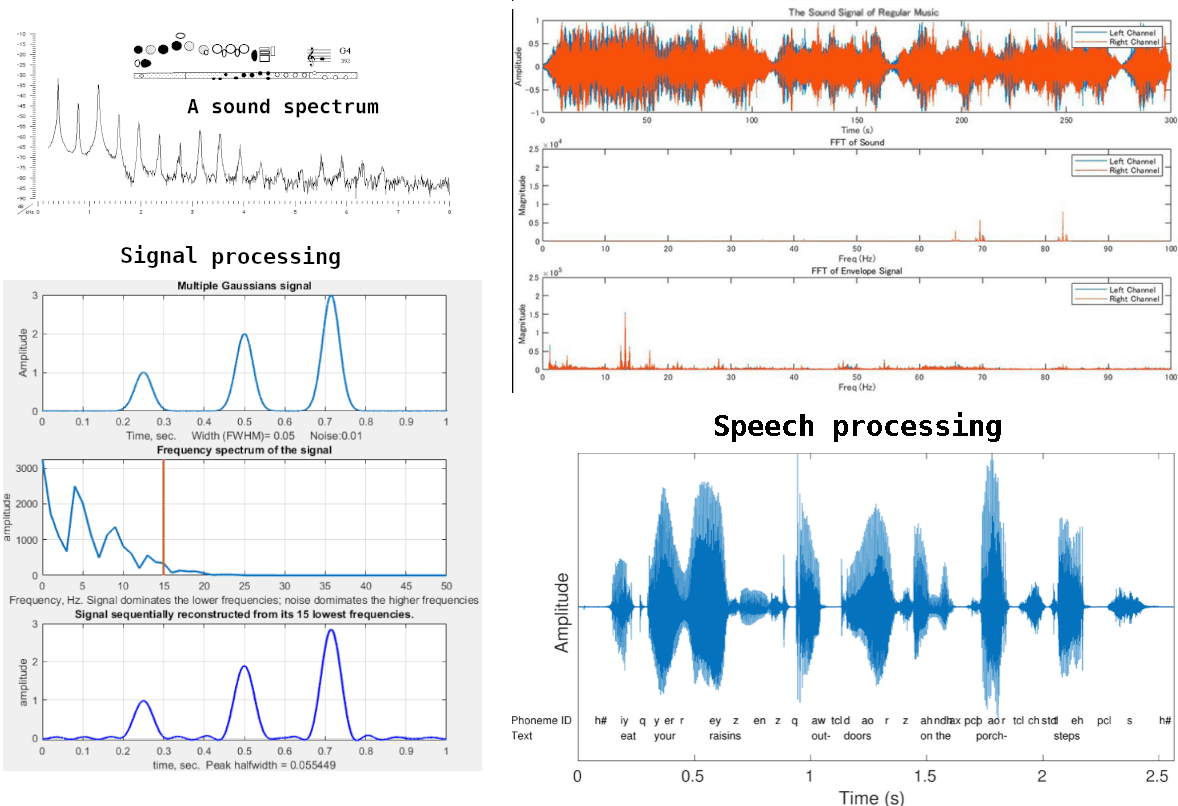
Today, Fourier series are essential in many scientific and technological fields.
Sound and music
- analyzing audio signals
- synthesizing musical sounds
- audio compression techniques that use frequency analysis (such as MP3)
Electrical engineering
- analyzing AC signals
- filtering noise
- circuit analysis
Image processing
- compression
- pattern recognition
- image filtering
Physics and engineering
- vibration analysis
- heat conduction
- wave mechanics
These ideas also led to the Fourier Transform, which is widely used in modern signal processing.
4. Understanding the Fourier Series Equation
A periodic waveform can be written as a Fourier series:
\[ f(x)=a_{0}+\sum_{n=1}^{\infty }(a_{n}\cos(nx)+b_{n}\sin(nx)) \]
The constant term
\( a_{0} \) is the constant (DC) component of the function.
It represents the average value of the signal over one period.
This shifts the entire waveform up or down, but it does not create oscillations.
Example:
If \( a_{0} \) = 2, the entire signal is shifted up by 2 units.
The fundamental frequency
Assuming a \( 2\pi \) period, the fundamental oscillation appears in the first sine and cosine terms:
\[ a_{1}\cos(x)+b_{1}\sin(x) \]
These terms correspond to the fundamental harmonic.
Higher harmonics
Higher terms
\[n=2,3,4,\cdots \]
represent higher harmonics, which are multiples of the base frequency.
Each harmonic adds more detail to the waveform.
General form of the Fourier series
The more general form shows the frequency explicitly:
\[ f(t)=a_{0}+\sum_{n=1}^{\infty }[a_{n}\cos(n\omega_{0}t)+b_{n}\sin(n\omega_{0}t)] \]
where:
- \( \omega_{0} \) : fundamental angular frequency
- \( n\omega_{0} \) : angular harmonic frequencies
Thus:
- n =1 gives the fundamental harmonic
- n > 1 gives the higher harmonics
5. Visualizing the Fourier Terms
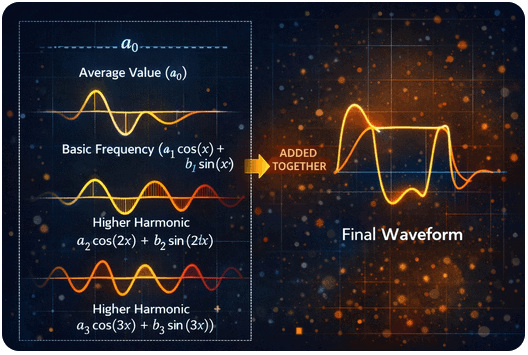
Each term in a Fourier series adds a new sine or cosine wave to the signal.
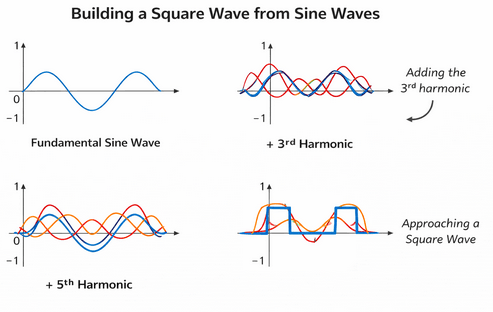
As more harmonic terms are added, the resulting waveform becomes a closer approximation of the original periodic signal.
Near sharp jumps (such as square waves), Fourier approximations can show oscillations and overshoot near discontinuities, a phenomenon called the Gibbs phenomenon.
This process explains how even complicated waveforms can be reconstructed from simple oscillations.
📝 Summary
- History: Developed by Joseph Fourier while studying heat flow.
- Need: Real-world signals are complex and difficult to analyze directly.
- Idea: Represent complex periodic waves as combinations of simple sine and cosine waves.
- Use: Essential in sound processing, engineering, physics, and digital technology.
The key insight is simple but powerful:
- Many periodic waveforms can be represented or approximated using combinations of sine and cosine waves.
Categories